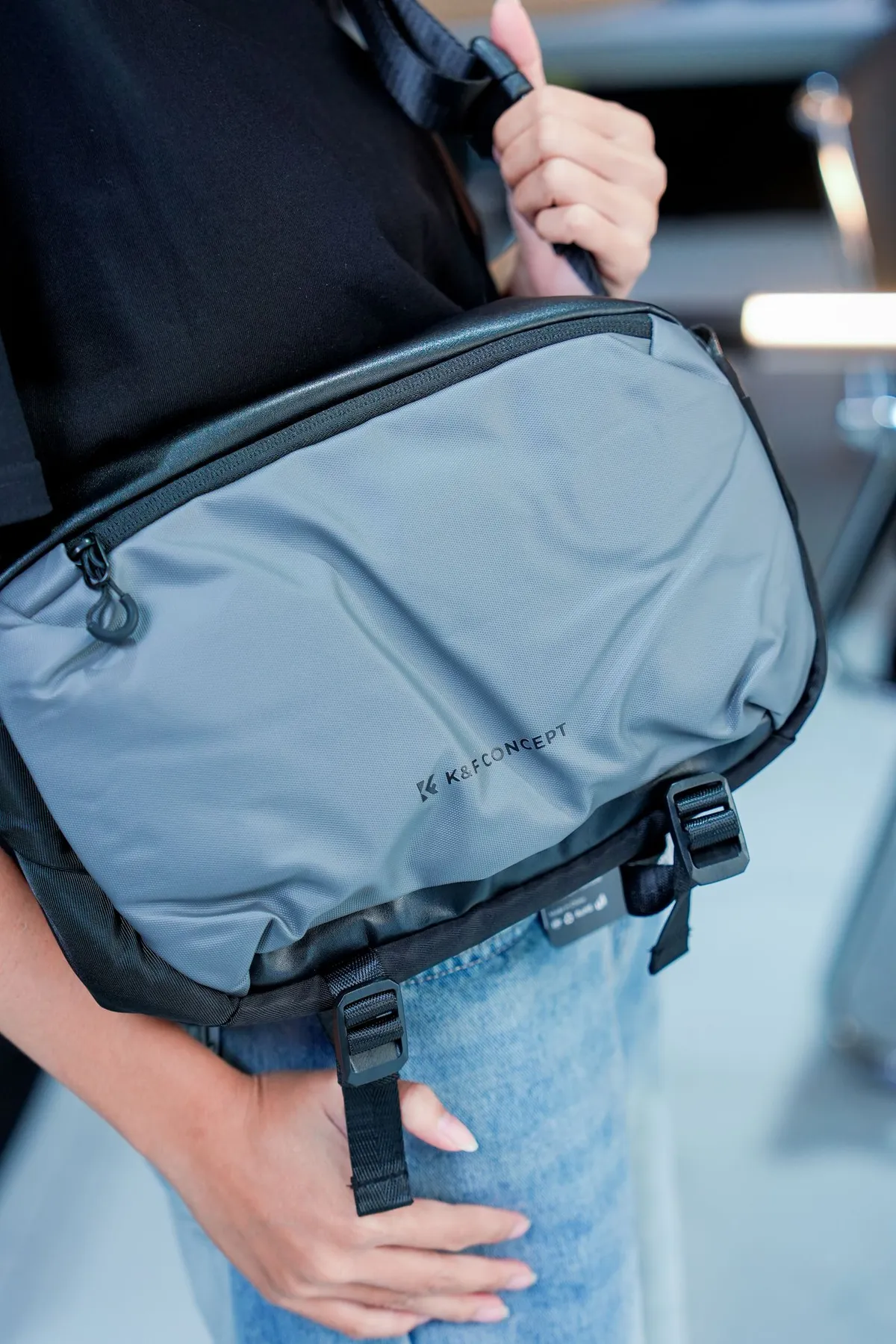
Picture the moment you arrive at a train station in an unfamiliar city. One hand holds a weekend bag, the other needs your phone, and your ticket is somewhere beneath a bulky wallet. A well-chosen crossbody can simplify that moment. The useful question is not how much a compact bag can hold when carefully stuffed, but how easily you can retrieve what you need while moving through a normal day.
For an everyday version of the same problem, think about errands: keys at the front door, a card at the checkout and a phone when a message arrives. List those essentials first. Travel may add a passport, small battery pack or glasses case, but it does not necessarily require a much larger bag if those additions replace other items.
Test access as well as capacity
Measure your largest essential, often a phone or glasses case. Compare its dimensions with the internal compartment and the opening. A narrow zip can make an object difficult to remove even when there is sufficient room inside. Look for a photograph with the bag open, and check whether internal pockets consume the space you need.
During a permitted try-on, put in your everyday load and retrieve the phone without taking everything else out. Repeat with the bag worn across your body. A flap that looks elegant on a table may require two hands to manage; a magnetic fastening may be convenient but provide a different kind of closure from a zip. Choose deliberately rather than assuming every small bag works alike.
Make the strap fit your layers
An adjustable strap is useful when the bag moves between a winter coat and a light shirt. Check the minimum and maximum strap length, especially if you have strong preferences about where the bag sits. A detachable strap also changes the carrying options, though the attachment hardware needs inspection just as much as the strap itself.
Wear the bag where you expect to keep it and walk a few steps. Notice whether it swings, whether the strap twists and whether the position allows easy access. A broad strap may spread the contact differently from a narrow chain, but width alone cannot establish how a loaded bag will feel. Try the actual configuration rather than judging the accessory in isolation.
| Your main use | Detail worth prioritizing | What may be unnecessary |
|---|---|---|
| Grocery and pharmacy errands | Quick access to keys and payment | Several passport-sized compartments |
| A day of sightseeing | Adjustable strap and organized essentials | Capacity for every item in the suitcase |
| Dinner after a day out | A finish that suits both outfits | A second bag solely for the evening |
| Travel with a separate backpack | Space for frequently needed items | Another large main compartment |
Buying checklist
- Check the phone, passport or glasses case against usable measurements.
- Inspect the closure and how it operates while the bag is worn.
- Compare strap length with your height, preferred position and outerwear.
- Look at hardware attachment points and the lining in detailed photographs.
- Read the cleaning instructions before choosing a light color for frequent use.
- Confirm return conditions, particularly for personalized or final-sale pieces.
- Test the loaded bag, rather than using empty weight as the only comparison.
Nordstrom and Everlane provide starting points for comparing crossbody silhouettes. Filter by the measurements and materials you need, then open individual product pages. A description such as travel-ready is a shopping label; it does not establish security, weather protection or a fit for your particular belongings.
Tradeoffs
A very compact bag can make you edit your load, which is useful until it forces essential items into unreliable pockets elsewhere. A larger crossbody gives more room, but that room can invite unnecessary packing. Choose a size that leaves a little working space around the essentials so opening and closing the bag remains easy.
Compartment count is another compromise. Several zipped sections help separate things if you remember where you put them. For someone who searches every pocket for keys, one main compartment and a small inner pocket may be simpler. Organization is only successful when it matches your habits.
Keep practical expectations
No ordinary bag removes the need to pay attention to your belongings. Use its closures and carry it in the way appropriate to your surroundings; do not treat a fashion label or a body position as a security guarantee.
Do I need a separate travel bag? Often an everyday crossbody can do both jobs if the additional essentials fit and its carrying arrangement suits the trip.
What if my bottle does not fit? Decide whether it belongs in your larger bag, hand or a different carrier. Enlarging every accessory around one item can defeat the reason you wanted a compact crossbody in the first place.